
THE IMPACT OF DEEP TECH ON MODERN MARKETING INNOVATIONS, CONSUMER BEHAVIOR & STRATEGIC ADAPTION
Author: Neha Sonawane, Sakshi Nigam ,Ananya Gupta , Nischay Jain DOI: https://doi.org/10.68120/IC2425C12 Page Numbers:74 to 80
Abstract: In the last 20 years, new technology has changed a lot in marketing. Now, many Businesses uses tools like blockchain, AR, AI, and big data to improve the connection with people and promote their products. This study shows about how marketing methods have changed from 2001 to 2025. Back in the early 2000s, to reach their customers, companies mostly used websites, emails, and regular ads and many more. But in the 2010s, because the social media became very popular, and that changed everything. So now Brands started using digital marketing more, to teamed up with influencers, to promote their brands and to gain more customers attention.
By the 2020s, modern technologies like blockchain, AR/VR, and AI have become really important for helping businesses to connect better with their customers. As we come closer to 2025, many companies are using AI-powered tools like chatbots, data analysis, and tools that can help to predict customer behavior for more personalized and interesting experiences.
This study shows that how marketing has changed a lot over time by going through real-life examples, industry reports, and research articles. The findings show that companies are always adapting and improving to stay ahead in today’s digital world. even though technology has changed a lot and have adapt new technologies which has opened many new ways for brands to reach people, it has also brought many challenges like data privacy concerns, the right way to used of AI, and keeping up with what customers expect. If the businesses wants to build long lasting good relationships with customer’s, then they need to learn and find the right balance between using new technology and being responsible for it.
INTRODUCTION:
According to Moore (2010), “crossing the chasm” is one of the biggest challenges for tech companies. This is about going from a small group of users to a much bigger one. But bigger markets don’t always act the same way. It’s not easy, and companies need to understand how different people are if they want to sell more. as technology has advanced, it’s become harder for many people to understand or use it in daily life (Parasuraman, 2000). For customers, it’s often confusing to decide whether to try something new. Over the last 20 years, technology has completely changed how marketing works and how people behave as buyers.
Because of this, the fast rise of digital tools, data tracking, and automation has changed the way businesses connect with people. Back in the early 2000s, most companies just used websites, emails, and regular ads. But by the 2010s, social media became popular, and marketing started focusing more on those platforms.
Companies connect with their customers have changed a lot in recent years, due to new technologies like artificial intelligence (AI), blockchain, augmented reality (AR), and big data. These tools help make marketing more personal, engaging, and interactive transparent. To understand customer behavior, to predict future trends, and create better marketing experiences many companies uses AI, AR/VR to stay competitive in the market.
Now a days to reach the right users/ people, Modern marketing depends on influences, social media, and personalized ads. While the new technologies have many new opportunities but, they also create new problems. Companies now face many challenges of data privacy, and
check if AI is used in a fair way, and managing customers want.
This study shows how technology changed consumer behavior and marketing strategies from 2001 to 2025. It uses real examples, surveys, and reports to understand how businesses are adapting to these changes. It also highlights the ethical concerns that come with using customer data in marketing.
LITERATURE REVIEW
The Development of Technology in Marketing (2001–2025).
In the early 2000s, when companies mostly used websites, email campaigns, and online advertising to connect with customers, it was due to digital marketing that began in the early 2000s. So the marketing strategies were made to become more individualized, social, and interactive in the 2010s as social media platforms like Facebook, Instagram, TikTok, and Twitter gained traction (Tuten and Solomon, 2017). By 2020, technological developments were done in the like big data analytics, artificial intelligence (AI), and AR/VR experience had changed, how consumers interacted with brands, claims Chaffey (2020). This made it possible for highly customized marketing and deeper interaction with brand messaging.
Artificial Intelligence and Personalized Marketing
To better understand consumer behavior, Smith & McKeen (2019) claim that AI has made it possible for businesses to deliver highly targeted content, segment audiences more successfully, and use predictive analytics. AI’s capacity to create more volumes of user data and customize experiences to suit individual preferences directly leads to personalized recommendations, like those found on websites like Amazon and Netflix. Actually, by presenting pertinent goods or services, AI-powered recommendation systems are now crucial in influencing consumer purchase decisions since they reduce decision fatigue (Huang & Benyoucef, 2017). Customers often feel more satisfied with their shopping experience when they receive personalized recommendations because it appears that the business is more aware of their preferences, according to research by Lamberton and Stephen (2016).
ConsumerEngagement with Augmented Reality (AR)
Augmented reality (AR) is another important technological development that has made easy for consumers to engage with products before making purchasing decisions. Now using augmented reality, Users can see products in the real world through mobile applications that use augmented reality (AR), making for good shopping experience. Particularly in the retail and real industries, the impact of AR on consumer behavior is becoming increasingly evident. According to Rau Schnabel et al., IKEA’s augmented reality app, for instance, allows users to virtually arrange furniture in their homes to see how it fits and complements their interior design, significantly reducing uncertainty in purchase decisions. in 2020).
Big Data and Predictive Analytics
For the marketers who trying to better understand the preferences and behavior of their target audience uses big data tool for predictive analytics . Because data analytics tools provide useful information that helps with better decision-making and more accurate targeting, businesses can now track customer behavior in real time (Wedel and Kannan, 2016). Currently, marketers use vast datasets, from demographic information and purchase trends to browsing histories and social media activity, to create highly customized marketing campaigns.
Blockchain Technology and Transparency
Blockchain Technology and Transparency Despite being primarily associated with cryptocurrencies, blockchain has begun to gain traction in the marketing sector because of its capacity to boost online transaction transparency and trust. Blockchain technology enables a decentralized ledger system that protects against fraud and ensures data integrity.
Because blockchain technology tracks customer interactions and validates ad impressions, it has the potential to address persistent issues with ad fraud and data mismanagement in marketing (Zohar et al.2019) Block chain technology may be a powerful tool for rebuilding consumer trust in digital marketing by ensuring accountability and providing verifiable transaction records (Tapscott and Tapscott, 2017). Ethical Implications and Consumer Trust The ethical implications of big data, AI, and AR technologies continue to be a major concern as they continue to transform marketing.
Ethical Concerns and Consumer Trust
As tools like big data, AI, and AR keep changing how marketing works, people have started worrying more about what’s right and wrong. One big concern is that AI in marketing might take away a person’s freedom to make their own choices.
Some experts are worried that this kind of tech can influence people too much or even push them into buying things they normally wouldn’t (Eubanks, 2018). Even though AI can make marketing smarter and more useful, it can also use people’s habits and emotions in a way that’s not fair. This might lead to problems like showing ads only to certain groups or getting results that are biased because of how the algorithm works. For businesses using these tools, gaining and keeping customer trust is really important especially when they’re dealing with people’s personal data.
Laws like the GDPR in Europe have set strict rules to protect customer data, and many other countries are planning to follow the same path. This study looks into how marketing strategies and consumer behaviour have changed because of technology over the last two decades. It also explores the ethical side of using digital tools in marketing, especially the impact on trust and privacy.
OBJECTIVES
How Modern Marketing is Shaped by Deep Tech (AI, AR, Big Data, and Machine Learning).
Technologies like artificial intelligence (AI), augmented reality (AR), big data, and machine learning have made a big difference in last 20 years in the marketing . In the early 2000s, marketing were done through basic tools like websites, emails, and regular ads. But now, with the help of modern technology tools , marketing has become smarter and more customize. So to understand the customers needs and wants, these tools AI, AR and big data helps companies to understand it better. Machine learning allows businesses to predict trends and customer needs, helping them plan better campaigns. Overall, deep tech has completely changed the way businesses connect with people.
How AI Personalization and Digital Tools Affect ConsumerBehaviour and Brand Interactions.
So, to feel more personal to each customers the AI helps brands to show ads and content. This is called personalization or customization, and it affects how people shop and how they feel about certain brands. When people want to see products that matches their style or tastes, so they take the help of smart tools like chatbots, through which they are likely to trust and interact with that brands. Personalized marketing makes customers feel understood, which can lead to stronger brand loyalty and faster buying decisions. AI also tracks what people like, which helps businesses adjust their strategies in real-time to fit customer needs better.
Challenges Businesses Face in Using Deep Tech for Marketing
Companies face challenges using deep tech for marketing even though deep tech has many benefits but using it in marketing is not always easy. The main problem is the cost of these technologies especially for the small companies. Another issue is lack of skilled people who know how to use these technologies and to train people the cost is needed and important concern is hoe consumer data is is collected and used which raises privacy and ethical questions so deal with this problem companies need to invest in training and all this is need high cost and have to choose tools that suit their budget, and be transparent about how they use data. Following laws like the GDPR and using data responsibly can also help build consumer trust.
How Well AI Tools Work for Customer Engagement and Sales
To interact with customers and to understand their wants companies use AI-powered tools like personalized ads, virtual try-on AR features, and chatbots have made a big impact on companies and customers. These tools make customer service faster and more helpful, which keeps customers happy. For example, chatbots can answer questions anytime, and personalized ads show people things they’re actually interested in. AR lets customers see how a product looks or works before buying it. These tools not only make customers more engaged but also help increase sales by making the shopping experience smoother and more enjoyable.
RESEARCH METHODOLOGY
This research uses a primary research method by collecting data from the survey responses . The goal was to understand how deep tech is affecting marketing. The survey data were collected from the college students and business . Along with the survey, academic articles and studies were also reviewed to support the findings. The systematic questionnaire aimed at students, professionals, and entrepreneurs, emphasizing AI- based personalization, privacy issues related to data, consumer behavior in online shopping, and new technologies such as AR. Nonprobability convenience sampling was employed, and the answers were analyzed based on descriptive statistics and represented using charts.
Secondary data from Google Scholar, JSTOR, and business reports were used for further context. Ethics measures were put in place to maintain anonymity and voluntary response without collecting any sensitive information. Although the research presents useful information, limitations in sample size and geographic location exist. More research can build on this study with a larger sample size and population to further understand the role of deep tech in marketing.
DATA ANALYSIS
Quantitative data from the survey was analyzed using appropriate statistical methods to identify trends and patterns in responses. Qualitative data from the literature review was analyzed through thematic analysis to extract key themes and insights.
Table no 1: Age Group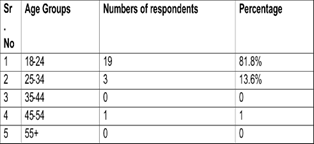
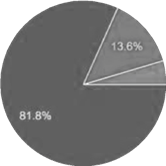

Chart No. 1
As seen in chart no 1 which is referred to from table no 1, the data we have collected consists of the candidates from various age groups such as 18-24 (approx. 81.8%), 25-34 (approx. 13.6%), 35-44 (0 %), 45-54(approx. 1%) and 55+(0%).
| Sr.no. | Occupation | No. of respondents | Percentage |
| 1 | Student | 16 | 72.7% |
| 2 | Working Professional | 4 | 18.2% |
| 3 | Business Owner | 2 | 4.5% |
| 4 | Housewife | 1 | 1% |
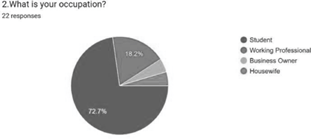
Chart No. 2
As seen in chart no 2 which is referred from table no 2, the data we have collected consists of the candidates from various fields such as student (approx. 72.7%), working professional (approx. 18.2%), Business owner (approx. 4.5 %), and housewife (approx. 1%).
From the above 2 tables and charts indicates that the majority of the survey respondents are young adults between 18-24 years old, who are mostly students, followed by working professionals. This indicates that younger people, especially students, are more active on digital platforms and new technologies.
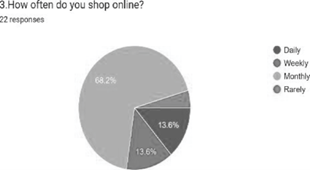

Chart No. 3 & 4
As seen in chart no 3 & 4 the data we have collected from the candidates consists of how often the candidates shop online on daily basis approx. 13.6 %, weekly approx. 13.6%, monthly approx. 68.2% , and rarely approx. 1 % and in 4th chart shows that how frequently the personalized ads based on their browsing or shopping behavior comes , very frequently approx. 68.2%, sometimes approx.27.3%, rarely approx. 1 % and never 0 %. AI-Powered Marketing and Online Shopping : A significant portion of respondents shop online at least once a month, with a smaller group making purchases weekly or daily. Most consumers regularly notice personalized ads based on their browsing behavior, indicating that targeted advertising is highly prevalent.

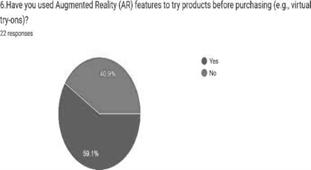
Chart no 5 & 6
As seen in chart no 5 & 6 the data we have collected from the candidates consists of how much they trust AI-powered recommendation when shopping online e.g. Amazon, Myntra, Flipkart, meesho, ajio, etc. so 63.6 % says yes they trust on AI and 13.6 says no and 22.7% are not sure. In 6th chart shows that how many candidates have used Augmented reality(AR) features to try products before purchasing e.g virtual, try in on. So 59.1% says yes and 40.9 % say no.When it comes to AI-based recommendations, more than half of the participants trust AI recommendations while shopping online, although some are not convinced. Moreover, over half of the participants have utilized Augmented Reality (AR) capabilities while shopping, which shows the increasing use of immersive technologies in online shopping.
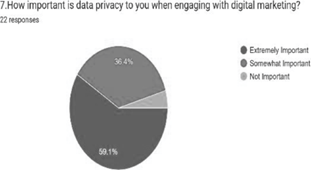
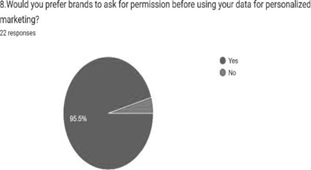
Chart 7 & 8
As seen in chart no 7 & 8 the data we have collected from the candidates consists of how important is data privacy to you when engaging with digital marketing so 59.1% approx. is extremely important , and somewhat is approx. 36.4%. In 8th chart shows that how many candidates prefer brands to ask for permission before using your data for personalized Chart no 9 & 10 As seen in chart no 9 & 10 the data we have collected from the candidates consists of the company using AI driven tools for marketing , so 50% of company’s says yes and 27.3 says no and 22.7% are planning to implement. In 10 the chart shows how effective has AI driven marketing been for customer engagement , so 40.9% are very effective, 54.5% are somewhat. Half of the companies surveyed are already Chart 11 : As seen in chart no 11 the data we have collected from the candidates consists of the biggest challenge in adopting deep tech for marketing , cost implementation approx. 27.3%, data privacy concerns approx. 36.4%, lack of expertise approx. 22.7%, consumer trust issues approx. 13.6%. Although it has benefits, various issues prevent deep tech from being applied extensively in marketing. Data privacy is the largest challenge, followed by the expensive nature of implementation. The absence of specialized expertise and consumers’ lack of trust are also major hindrances. These results highlight increased dependence on AI and deep tech in marketing and also the necessity of responsible data use and consumer confidence. Businesses need to strike a balance between innovation and privacy protection to drive customer engagement and build long- term loyalty. marketing so 95.5 % is yes and 5.4% is no. Privacy of data is also a key concern, with a majority of respondents viewing it as extremely important or somewhat important. Almost all participants would like brands to seek permission before using their personal information, indicating the necessity for companies to prioritize transparency and ethical use of data.
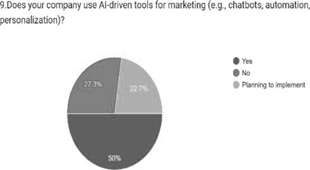
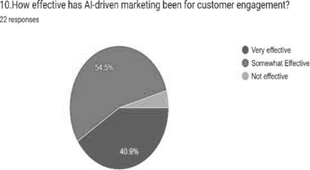
Chart no 9 & 10
As seen in chart no 9 & 10 the data we have collected from the candidates consists of the company using AI driven tools for marketing , so 50% of company’s says yes and 27.3 says no and 22.7% are planning to implement. In 10 the chart shows how effective has AI driven marketing been for customer engagement , so 40.9% are very effective, 54.5% are somewhat. Half of the companies surveyed are already making use of AI-powered tools including chatbots, automation, and targeted marketing. A quarter of organizations intend to implement AI in the near future, with the rest having not yet explored it. In terms of effectiveness, most respondents have a positive opinion that AI-powered
marketing positively affects customer engagement, although a handful are not convinced.

Chart 11 : As seen in chart no 11 the data we have collected from the candidates consists of the biggest challenge in adopting deep tech for marketing , cost implementation approx. 27.3%, data privacy concerns approx. 36.4%, lack of expertise approx. 22.7%, consumer trust issues approx. 13.6%. Although it has benefits, various issues prevent deep tech from being applied extensively in marketing. Data privacy is the largest challenge, followed by the expensive nature of implementation. The absence of specialized expertise and consumers’ lack of trust are also major hindrances. These results highlight increased dependence on AI and deep tech in marketing and also the necessity of responsible data use and consumer confidence. Businesses need to strike a balance between innovation and privacy protection to drive customer engagement and build long- term loyalty.
HYPOTHESIS
H₀: Deep tech innovations (AI, big data, AR, automation) have no significant impact on marketing effectiveness.
H₁: Deep tech innovations significantly improve marketing effectiveness and consumer engagement.
VARIABLES
Independent Variable: Use of deep tech in marketing
Dependent Variable: Marketing effectiveness, consumer engagement.
FINDINGS
Consumer Awareness & Use of AI in Online Shopping
Alarge number of people (66.7%) often come across ads that are tailored to their interests, which shows that AI-powered marketing is working well to reach the right audience. Also, more than half of the respondents (57.1%) have used Augmented Reality (AR) to try out products before buying. This shows that people are becoming more open to using new and interactive tech in their online shopping experience.
Trust and Privacy Concerns
Even though 66.7% of the people trust AI recommendations, 23.8% are still unsure, and 9.5% don’t trust them at all. This means that companies need to be more open about how their AI systems make decisions. A very high number of respondents (95.2%) said they prefer it when brands ask for permission before using their personal data. This clearly shows that privacy is still a big concern for most consumers.
How Businesses Are Using AI for Marketing
Almost half of the businesses (47.6%) have already started using AI tools for marketing. However, 28.6% have not used AI yet, and 23.8% are thinking about it. When it comes to how effective AI marketing is, 42.9% of participants said it works very well, while 52.4% felt it works to some extent. This means that most people see AI as a useful way to connect with customers.
Problems Faced in AI Marketing
The main issues businesses face with AI marketing are privacy concerns (33.3%), high setup costs (28.6%), lack of skilled professionals (23.8%), and consumer trust (14.3%). These problems show that while AI has great potential, companies still need to deal with technical, financial, and ethical challenges before they can make full use of it.
SUGGESTIONS
1. Before collecting any personal information the should ask for permission before using it directly: While using AI based tools companies should be honest about how they use data . It’s important to explain this clearly to users. Respecting customer choices is important—not just for trust, but also to make sure companies are following data privacy laws.
2. Cutting AI Costs and Building Skills : To make AI more affordable, companies should choose low-cost tools that fit their budget. This helps them avoid the high expenses that often come with new technology. At the same time, training employees to use AI tools can make a big difference. When staff know how to use these tools properly, marketing becomes easier, faster, and more effective.
3. Dealing with Privacy and Security Issues : Privacy is a big concern. To protect customer data, companies should use strong security measures—like encryption and hiding personal information (anonymization).They also need to act responsibly. Following ethical guidelines and sticking to global privacy laws, like GDPR in Europe or CCPA in the U.S., is key to building and keeping customer trust.
4. Using Personalization and AR to Attract Customers:Personalized content and tools like AR (augmented reality) can help companies grab attention and keep customers interested. When people feel that a brand understands them and offers a unique experience, they are more likely to stay loyal and engaged. Since more than half of the people (57.1%) have already used Augmented Reality (AR), businesses should keep investing in these interactive tools to make shopping more exciting. Also, when using AI for personalization, it’s better to suggest things based on what users are doing at the moment (context) rather than just targeting them. This helps keep the customer’s experience more natural and respectful.
CONCLUSION
This study looked at how both companies and customers feel about using AI in marketing, especially when it comes to trust, privacy, and technical challenges. The results show that more and more people are using AI features like personalized recommendations and AR (Augmented Reality) while shopping.
But at the same time, businesses still face some big problems like high costs, lack of proper skills, and concerns about keeping customer data safe. Even though AI in marketing seems to work well, the study clearly shows that people only trust it if brands are open about how they use data and follow ethical practices. Most participants (95.2%) said companies should always ask for permission before using their data, which shows how important strong data rules are.
That said, the study had a small group of only 21 people, which means the results might not apply to everyone. In the future, more research with a larger and more varied group could give better insights into how AI is changing marketing and customer habits. Overall, AI has a lot of promise in marketing, but it will only work well if companies use it responsibly, focus on what customers really need, and keep improving their technology.
REFERENCES
AI and Big Data Analytics: Driving Innovation in Ecommerce and Customer Experience.” ResearchGate, 2024.
Artificial Intelligence Marketing.” Wikipedia, 2025.
Here’s How Technology Has Changed the World Since 2000.” World Economic Forum, 2020.
How Businesses Can Leverage AI, IoT, AR, VR, Blockchain, and Big Data to Retain Customers.” BBN Times, 2023.
Sorry, Mad Men. The Ad Revolution Is Here.” The Wall Street Journal, 2025.
Synergies.” Wikipedia, 2025.
The Effects of Strategic Orientations on Technology- and Market-Based Breakthrough Innovations.” Journal of Marketing, 2023.
The Future of Market Analysis: Exploring Emerging Technologies and Innovative Approaches.” Comparables.ai, 2025.
The Impact of New Technological Changes to the Marketing Strategy Formulation.” Academia.edu, 2023.
The New Essential Eight Technology Trends.” PwC, 2025.
AI Marketing Trends in 2025.” Smart Insights, 2025. The Application of AI, Blockchain, Cloud, and Data Analytics.” NSF Public Access Repository, 2020.
The New Renaissance: Can Businesses Build HumanCentric Tech?” The Australian, 2025.
Dataquest. (2024). The impact of emerging enterprise tech on digital marketing.
Economic Research Ekonomska Istraživanja. (2023). The impact of technological innovation on marketing.
The Verge. (2025). The future of the internet is likely smaller communities, with a focus on curated experiences.