
DEEP TECH IN SPORTS MAKING SPORTS ACCESSIBLE FOR VISUALLY CHALLENGED PLAYERS
Author: Mercy Fernandez, Aniket Dilip Bhujbal, Radhika Dipak Mantri, Pranav Bhupesh Lakhe, Gargi Dilip Jaunjal, Vrushali Limaye DOI: https://doi.org/10.68120/IC2425C7 Page Numbers: 40 to 47
Keywords: Visually Challenged, Sports, Deeptech
Abstract: This study explores how developments in deep technology can increase sports accessibility for visually impaired players. Following the review of available literature on standalone technologies, the paper identifies obstacles hindering athletes with visual impairments from competing and performing at greater levels and map out innovative solutions that overcome these deficits.
The research demonstrates that visually impaired athletes are able to achieve their independence and safety through sports equipment or wearable technology with incorporated sensors and AI navigators. This research tries to address the challenges of visually challenged players by taking the case studies of players from Fergusson College, Pune . It demonstrates the need for embracing a deep collaborative strategy for developing distinctive digital solutions for sports in favor of inclusion and diversity.
The paper highlights various types of devices that use diverse technologies to augment sports training for sports. The list of devices and technologies is extensive, describing their usage, benefits, and effects on players. The paper tries to create awareness among visually challenged individuals and urges them to play the sport of their choice by using the deep tech that is available.
The necessary recommendations are given to the concern for the advancement in technology for visually challenged players to play sports. This initiative aims to learn about current technology and how it can be adapted by visually impaired sports people. The research aims to create awareness and encourage the uptake of these solutions to make the sporting experience more inclusive for the visually impaired.
INTRODUCTION:
The Paralympic Games or Paralympics is a periodic series of international multisport events involving athletes with a range of disabilities. There are Winter and Summer Paralympic Games, which, since the 1988 Summer Olympics in Seoul, South Korea, have been held shortly after the corresponding Olympic Games.There are an estimated 4.95 million people blind (0.36% of the total population), 35 million people visually impaired (2.55%), and 0.24 million blind children in India.Cataract and refractive error remain the leading causes of blindness and visual impairment, respectively, in India (Wadhdwani et al., 2020, Khanna., 2018).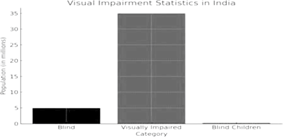
Figure No. 1 Visually impairment Statistics of India
There have been significant developments in the field of Visually challenge prevention, management, and control since the “Vision 2020: The right to sight” initiative by Rao, G. N. (2000) has been implemented over the last two decades. Deep technology or deep tech refers to advanced technologies based on some form of substantial scientific or engineering innovation. The innovations are “deep” in a sense that they are sophisticated, very advanced to complex challenges or issues. Examples of deep-tech breakthroughs include genomics, robotics, nanotechnology and clean energy initiatives coming from research labs and academia. Deep tech differs from high tech, which refers more broadly to technical innovations and advancements Kerner, S. M. (n.d.) Retrieved February 25, 2025. The Sports which are Covered
1) Swimming
2) Chess
3) Judo
4) Cricket
5) Shot put
6) Running (Athletes)
OBJECTIVES
1. To highlight the format of different Paralympic games (Swimming, Chess, Judo, Cricket, Shot put, Running) for visually impaired athletes.
2. To understand the perspective of the visually impaired athletes of Fergusson college, Pune Maharashtra about the deep technology in the sports they play.
3. To understand the deep technology available for visually impaired athletes for games namely Swimming, Chess, Judo, Cricket, Shot put, Running (Athletes).
4. To suggest the concern for promoting deep technology for the visually impaired athletes.
RESEARCH PROCEDURE
● Thorough review of literature was done to identify the deep technology for visually impaired athletes for games namely Swimming, Chess, Judo, Cricket, Shot put, Running.
● Interview of the Visually Impaired athletes of Fergusson College , Pune was taken, of different games to understand the experiences and challenges.
● Different deep technologies for visually impaired athletes were studied using various research papers and articles.
● Important technology for each game for visually challenged athletes were analyzed and objective-wise research Procedure with its conclusion were noted.
OBJECTIVE- WISE PROCEDURE OF STUDY
Objective-1
The first objective is to highlight the format of different Paralympic games for visually impaired athletes.To fulfil this objective the following resources were taken into consideration – World para Swimming Classification & Categories – SB9, SM8. (n.d.),(International Braille Chess Association. (n.d.), International Blind Sports Federation. (2024, February 26),C.ho, H. C., Oh, H., Yoon, H., Jin, J., & Lee, J. W. (2018), International Blind Sports Federation.(2024), Panoutsakopoulos, V., & Panteli, F. (2013), Exercise Right. (2023, September 7)
Swimming
According to World para Swimming Classification & Categories – SB9, SM8. (n.d.) Swimming is classified for visually impaired into 3 categories
1. S11- No light perception to somewhat light perception and unable to recognize shape of hand.
2. S12 – They have ability to recognize shapes .
3. S13 -Visual acuity above 2/60 up to 6/60 . defined under IBSA International Blind Sports Federation which is the sight classification of B1,B2 and B3.
● B1 and B2 athletes have the most visual impairment.
● It is compulsory that B1 must wear darkened goggles.
Age specification
1. Masters: M1: 30 – 34 years, M2: 35 – 39 years, M3: 40 – 44 years, M4: 45 – 49 years, M5: 50 – 54 years, M6: 55 – 59 years, M7: 60 – 64 years, M8: 65 – 70 years, M9: 70 – 74 years, M10: 75 – 79 years and so on in gaps of 5 years.
2. Senior (18 years and above).
3. Junior B.16-17 years, C.14-15years, D.12-13 years, E:11 years or less (Precompetitive group).
Chess
In blind chess, players are typically categorized based on their level of visual impairment. The categories are designed to ensure fair competition. The main categories are:
1. B1 (Total Blindness): Players with no vision or the ability to perceive light, also referred to as totally blind. These players rely entirely on tactile boards, Braille notation, and auditory feedback.
2. B2 (Severely Impaired Vision): Players who have very limited vision but can still perceive some light or shapes, often using large print, magnification, or other visual aids during play.
3. B3 (Partially Impaired Vision): Players with some vision but who are still considered visually impaired. These players
may use low vision aids, such as magnifiers or large print, to assist in playing.
Blind people play chess using specially designed equipment and techniques to make the game accessible. A tactile chessboard with raised squares and Braille markings allows players to feel the positions of pieces, while tactile chess pieces have unique shapes or textures to distinguish them. Players announce their moves verbally, and an assistant or opponent moves the pieces accordingly. Braille notation is used to record moves on a score sheet, allowing players to document the game. International Braille Chess Association. (n.d.)
Judo
Analytic Hierarchy Process (AHP) is the decision-making framework, to enhance the performance of blind judo athletes. This methodology allows for an objective assessment of variables such as training intensity, psychological support, equipment adaptation, and coaching strategies. C.ho, H. C., Oh, H., Yoon, H., Jin, J., & Lee, J. W.
(2018) J1 and J2 are the two classes used in Para judo for athletes with visual impairments. J1 is for athletes who are blind or almost blind, while J2 is for athletes who are partially sighted.
Rules at the edge of contest area
– If the J1 is standing outside the contest area with two feet, the athletes stand outside and will not be penalized.
– Usually, a J1 contestant cannot be punished for going outside, but if a J1 athlete walks directly backward to the edge and steps outside, then the athlete can be penalized.
– The J1 athlete or deaf athlete can also be penalized when it is a method (repeatedly) to go outside.
– The J2 is standing outside with one foot, may possibly be penalized.
– The J2 athletes leaving the mat without action shall be penalized with Shido International Blind Sports Federation. (2024).
Cricket
The blind cricket has different categories of B1, B2, B3 and the players who cannot see anything comes in B1. They are 100% totally blind. They come in B1 category even if they can see a little bit of light. As per the rule they provide dark glass which takes away any light from their eyes. It is a must to have four players from the B1 category. The B2 category are the ones who could see up to 2 m and a minimum of three players must play in every match and the players in the B3 category see up to 6 m. Amaximum of four players can play in the game. B1 players make an impact. If a B1 player hits a single run, it is counted as two runs. And B1 must compulsorily bowl eight overs in any game, that is 40% of the bowling. Coming to the team composition: among the 11, there must be
● Aminimum of 4 B1 players.
● 3 of B2 players.
● Amaximum of 4 B3 players.
Shot put
According to World Para Athletics the following is the classification for the visual impairment – The three categories are as follows:
1. F11 – No light perception to some light perception but unable to recognize shape of hand.
2. F12- 2/60 visual acuity and can recognize hands shape.
3. F13- visual acuity above 2/60 up to 6/60.
In this sport /game, throws are taken from 2.135 m where measurements are taken from closest mark .This mark is made by the shot to the throwing circle.Athletes have 60 seconds to participate for throwing once they are called for the game to play.to throw the shot it must be kept close to neck and released above shoulder height.There are three throws in prelims round.The best throw out of all is recorded and that player with good score is selected.Ties are broken by comparing the throws. Panoutsakopoulos, V., & Panteli, F. (2013).
Running
Totally visually impaired athletes are divided into 3 categories1. T11 – In this category players are totally blind and run with blindfold and must have to run with a guide.
2. T12 -In T12 if player have some blurred vision , they have the choice to run by themselves or with their guides.
3. T13 – In this category the player is impaired but cannot use a guide.
For T12 athletes, the first thing the athlete and coach need to figure out is whether a guide is necessary or if the athlete can run well without one.
Track and field athletes who run with guides are amazing. They team up with sighted runners who stay right next to them, matching their pace. The guide helps by calling out any obstacles ahead and letting the athlete know how much of the race is left. Its a partnership that helps the athlete and guide to stay on the track and run their best.Exercise Right. (2023, September 7).
Thus the first objective is fulfilled in which the format of different games of Paralympic for visually impaired athletes precisely for games like swimming, Chess, Judo, Cricket, Shotput and Running were reviewed which helped the researchers to understand the format of different games to find the gap in the technological aspect which can be addressed in the objective 3 of this research paper.
Objective -2
The second objective is to understand the perspective of the visually impaired athletes of Fergusson college, Pune Maharashtra about the experience and challenges while playing sports and their perspective about deep technology in their respective games.
In a conversation with the players it was found that approx 1000 visually challenged people are there out of which 300 – 400 approx play sports. The total number of visually impaired students who play different sports from Fergusson college , Pune is 20 out of which 5 students are currently not playing sports and 5 due to studies are not in sports and 10 students who are currently playing different games were interviewed .
Table No. – 1 The total number of visually impaired athletes who were interviewed from Fergusson college, Pune, Maharashtra.
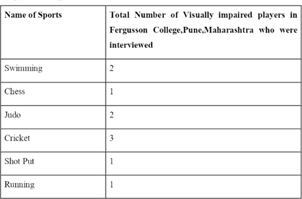
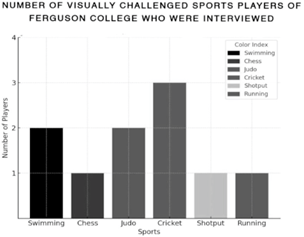
Figure No. 2 Number of Visually Challenged
Players of Fergusson College who were interviewed
1.Swimming
To understand the experience of the visually challenged swimming players a semi-structured interview was taken of the two players and they were selected based on their involvement and participation in the Swimming related events.
The key findings from the interview are as follows –
The player 1 is visually challenged and partially blind who has participated in state level swimming. Sportsperson arose a problem that visually challenged swimmers do not swim properly as they didn’t know the proper direction or track for swimming ,also they do not know the distance from where they should stop their swimming .From this analysis we conclude that sensors are required for visually challenged partial swimmers so that their track does not get mismatched. It is concluded that audio sensors or vibration sensors can also help swimmers to be in their track and guide them when to stop and when to flip.
Player 2 started swimming career from 5th standard.Swimmer’s highest achievements are 3 state level Gold ,1 national level Bronze. In swimming there are 4 Strokes
● Freestyle
● Backstroke
● Breaststroke
● Butterfly stroke.
All achievements are free and backstroke.
Age specification
● Masters: M1: 30 – 34 years,M2: 35 – 39 years,M3: 40 – 44 year, M4: 45 – 49 year,M5: 50 – 54 years,M6: 55 – 59 years,M7: 60 – 64 years,M8: 65 – 70 years,M9: 70 – 74 years, M10: 75 – 79 years and so on in gaps of 5 years.
● senior (18 years and above).
● Junior=B.16-17 years,C.14-15years,D.12-13 years,E:11 years or less (pre competition group).
In India ISBA (Indian Blind Sports Association) manages the competition for visually challenged people. Problems faced by players in swimming are usually for practice as people don’t allow them for practice because normal people don’t believe that they are able to swim. Government provides jobs when they win international tournaments. So, some technology should be there at least which enable visually challenged people to practice and track the progress to enhance their skills and achievements in sports.
2. Chess
To understand the experience and challenges of the visually challenged Chess players a semi-Structured interview was taken of 1 player and they were selected based on their involvement and participation in the Chess related events.
The key findings from the interview are as follows – Player 3 started a chess career from the school days and is National level chess champion, played and won the chess tournament during schooling days . School was the guideline for player’s chess life. As per player provided information, rules for visually challenged chess and for normal people are same. But there is a major change in chess board for visually challenged people, a structure of chess board is different like chess piece get fitted in chess board after a player’s move. AICF (All India Chess Federation) in India, looks forward to the competition and selects the players for the National and International chess competition.
3. Judo
To understand the experience and expectations of the visually challenged Judo players a semi-structured interview was taken of the 2 players and they were selected based on their involvement and participation in the Judo related events.
The key findings from the interview are as follows –
Player 4 started judo career in 5th standard in visually impaired school. Athlete’s school helped in journey achievement. Athlete’s biggest achievement in Judo is having national certificates in judo. The sportsperson played at school level and then at National level. For visually challenged people their uniform is designed differently. It has a different type of collar. The collar of the uniform has a specific grip to tackle a player. In judo, the rules for them are different. Player’s perspective is that it is the self-defense game, and this game should be for all at least everyone. The basic Technology is not needed in this game as it is a technique related game but for practice strength and stamina monitoring technology can be somewhat helpful.
Player 5 plays Cricket as well as Judo. Sportsperson started journey of success from 10th std in and schoolteachers guided and player also took training. Cricketer played in the commonwealth games. Firstly, sportsperson played at school level then at Taluka level and after that at National level he also got selected for championship but due to financial issues, the player couldn’t attend. This trainee practices weekly at Warje Sahyadri High School which is for visually challenged people. As such there is no requirement of technology in Judo. They just need mat because the game is based on technique.
4. Cricket
To undertechnologyence of the visually challenged Cricket players a semi-structured interview was taken of the two players and they were selected based on their involvement and participation in the cricket related events.
The key findings from the interview are as follows – After interviewing player 6 , the researchers came to know that, players started playing cricket from 7th Std. and from 11th standard, played for the team of Maharashtra in which he got the Man of series award. Cricketerplayed the matches which are conducted by the CABM (Cricket Association for Blinds ) which is run by government of Maharashtra. He played as a Wicketkeeper in the match. Sportsperson was selected for cricket during the 20-day camp. He is visually challenged partially, studying in Fergusson college Pune in Fy.BA Marathi. After that respondent told that there is no ground and machinery for regular practice and does only regular exercise. Also, players added that they play cricket with a ball that contain bell and the stumps are made up of metal. With help of this they get to know that the player is out or not but in that case they may get injured so they suggest that their stumps should have some sensors which will make sound, like normal cricket have stumps of red light and when the ball comes, it blinks so the deep technology like AI or sound related technology can be incorporated for safety.
Player 7 plays Cricket. In training phases they are facing coach issues, i.e. they don’t have a coach for training hence guidance is like they have to do by themselves. The main process starts from Taluka level, then it goes to the District.After winning at Taluka level, team goes to district level and
during district the further team is decided by their own as they face no expertise for the selection process. After that CABM (Cricket Association for The Blind Of Maharashtra) plays a vital role. They organize a camp for all state players and take a camp of 50 players and from them they make a team of 15 players and for Ranji trophy accordingly. Tech expectation are in the form that could help them for practice or coaching tips accordingly.
Player 8 has played National and currently playing Nagesh trophy (Ranji for blind). At the age of 13 he started his cricket career. Cricketer’s achievements are quite a lot faster from school to direct district and from district to state and then to National. Aim is to be part of Indian team and play International matches for India. Technology for improvement were suggested as voice input in stumps, batting practice machine (under arm ground bowling).
5. Shot Put
To understand the experience of the visually challenged Shotput players, a semi-structured interview was taken of 1 player and was selected based on involvement and participation in the Shotput related events.
The key findings from the interview are as follows –
Player 9 had played the Shotput in which participant achieved the highest best distance of shot put at 14 m. The Athlete started the journey of shot put from school, then played at Taluka, District level, and for the National & International level. When the sportsperson participated in Shotput, the best distance was 14 m at that time. At that distance, people were not even expecting that distance, so that point was not counted and participants did not get scores for that. Also, there is fear of injury that they should not get injured by the people around due to the throw. The throwing shot by visually challenged player should not hurt anyone, this precaution must be taken. Expectations of the player is
that an inbuilt speed breaker technology should be there, like structure should be installed as a priority and should be activated during the shot. This sensor should be activated when the ball is shot. It should have some kind of technology that can sense the people or objects around and stop the ball to keep the people around safe. This measure can be helpful to avoid injuries.
6. Running
To understand the experience of the visually challenged Running players a semi-structured interview was taken of 1 player and was selected based on involvement and participation in the Running related events.
The key findings from the interview are as follows –
Player 10 started running or practicing athletics in the first standard guided by a schoolteacher. Sportsperson belongs to Nanded and faced challenges while practicing individually, and sprinter always had the family support. This athletes’ achievements include 3 Gold and 1 Silver at the Paralympics at the national level. This sprinter also played internationally through the PRT selections. Ground practices include track understanding, knowledge of direction accuracy is required in the timing used, machines for the pattern recognition and movement tracking. They competed in ISBA and Paralympics, which are held by the committee of Maharashtra. The selection was based on timing certifications and MQS (minimum qualification standards).There are 3 levels: under 17 (junior), under 19 (sub junior), and above 19 (open), and there is no upper limit. The competition starts at school level and then at district level which are conducted in December in the schools which are specially for the blinds and then State levels. At the State level, there are 4 groups: 8–12, 13–16, 17–21, and 22–25 and from each state 3 qualifiers are taken for nationals. State level body manages the selections for the Paralympics selections and vacancies. In running there are 100 m, 200 m, 400 m, 800 m, 1500 m, and 5 km. These are the lengths for running. For Relay guidance is needed for the B1 category. Shared tracks are the same as those of the normal athlete, causing navigation difficulties. There is no marathon for the para-athletes. The longest event is 5 km, with a target of 19 minutes. Guides are there with athletes in the B1 category to maintain the track boundaries and show the path. Machines can be used for directions, guidance, and movement tracking.
The second objective is fulfilled by taking interviews to understand the perspective of the visually impaired athletes of Fergusson college, Pune Maharashtra about the experience, challenge and their technology expectations in the sports they play. This helped the researchers to understand the ground reality of the challenges and the available technology and the expectations of Visually challenged players in terms of technology for the sports they play.
Objective -3
The third objective is to understand the deep technology available for visually impaired athletes for games namely Swimming, Chess, Judo, Cricket, Shot put, Running (Athletes).
To fulfil this objective the following resources were taken into considerationFinke, B. (2021),Dartfish. (n.d.), Zebra Medical.(n.d), Sensoryx. (n.d.), Hartono, F., Tangkudung, J., Sukur, A., & Dlis, F. (2020), Cordellos, H. C. (1972), Anandaraj, P. R., Mahmood, N. H., Abdul Razak, M. A., & Zakaria, N. A. (2024), Woolsey, T. D., Woolsey, C. L., Strohmeyer, S., Walker, S., Otto, W., Cheshier, B. C. & Jacobson, B. H. (2020),Yuan, X., Cui, G., & Zhang, J. (2022) ,Vision Australia. (2023, July 3) , Blind Cricket England & Wales. (n.d.) , Blind Sport New Zealand. (n.d.),ChessBase.(n.d.),International Blind Sports Federation. (n.d.), Echo Hearing Solutions. (n.d.)
● Swimming
The development of sensor-based visually challenged swimming aids has helped in various technologies to help visually impaired individuals. These aids primarily utilize sensors and wearable devices to make swimmers free to swim in their environment Hartono, F., Tangkudung, J., Sukur, A., & Dlis, F. (2020) According to this paper the 3 types of sensors and its utilization are mentioned in the below image –
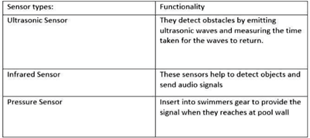
Figure No. 3 Types of sensors with it’s functionality
● Chess
One such technology was found named computer chess clock for blind players. It contains several accessibility options to enhance the inclusivity of gameplay. Such clocks typically contain push buttons that can be felt, audio signals for timers, and voice announcements for time remaining on each player’s side. Some also include customizable audio signals for time intervals or countdowns. These attributes enable visually impaired and blind players to monitor their game time effectively, which means they are able to compete on an equal basis with any other players. This technology creates independence and accessibility in the world of chess, providing a feasible solution for increasing gaming experience. Anandaraj, P. R., Mahmood, N. H., Abdul Razak, M. A., & Zakaria, N. A. (2024).
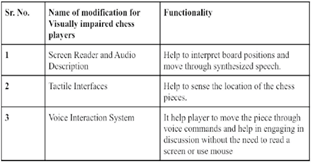
Figure No. 4 Modifications for visually Impaired Chess players
● Judo
According to Moein, S., Movahedi, M., & Ghasemzadeh, H. (2022) Eye-tracking devices are used to monitor where and how athletes focus their visual attention during a match. This helps researchers to understand the role of visual cues in Judo techniques and strategies.Other such technology is Motion capture system which record and analyze the athlete’s body movements to assess coordination and positioning during a match. It allows researchers to explore how athletes struggle for a lack of sight or rely on other senses to perform effectively.Jara, A., & Cifuentes, C.(2021) According to Yuan, X., Cui, G., & Zhang, J. (2022) VR technology could be used to simulate training environments where athletes practice Judo without sight. This helps in studying how athletes adapt to fighting without visual input and rely more on other sensory cues such as touch or hearing. The wearable sensors might measure physical parameters like balance, speed, and force, which are important for understanding performance in judo, especially when vision is impaired.
● Cricket
According to Vision Australia. (2023, July 3) The cricket ball or the Audible ball used in blind cricket has ball bearings inside it, which make a rattling sound when it is moving. This sound allows players to locate the ball by sound, helping them in both batting and fielding. The wickets in blind cricket are usually wider which make it easier for players to hit the stumps while bowling or fielding.Blind Cricket England & Wales. (n.d.) Pitch Side Markers are another modification. Some grounds are equipped with audible sound markers that help players understand their position on the field. This could include devices that beep at regular intervals or in response to movement Blind Sport New Zealand. (n.d.)
● Shot Put
According to Woolsey, T. D., Woolsey, C. L., Strohmeyer, S., Walker, S., Otto, W., Cheshier, B. C.,& Jacobson, B. H. (2020) For athletes with visual impairments, audible markers can be placed along the throwing circle. These markers emit sound when the athlete is within the correct position or to help them orient themselves on the field. The sound can help the athlete understand where they are in relation to the circle and the boundaries, improving their accuracy and confidence in the throw. Refer Table No. – 2 Device name and it’s working for different types of sports Thus, the third objective of the study is fulfilled in which different research papers were analysed to understand the deep technology available for visually impaired athletes for games namely Swimming, Chess, Judo, Cricket, Shot put, Running(Athletes).

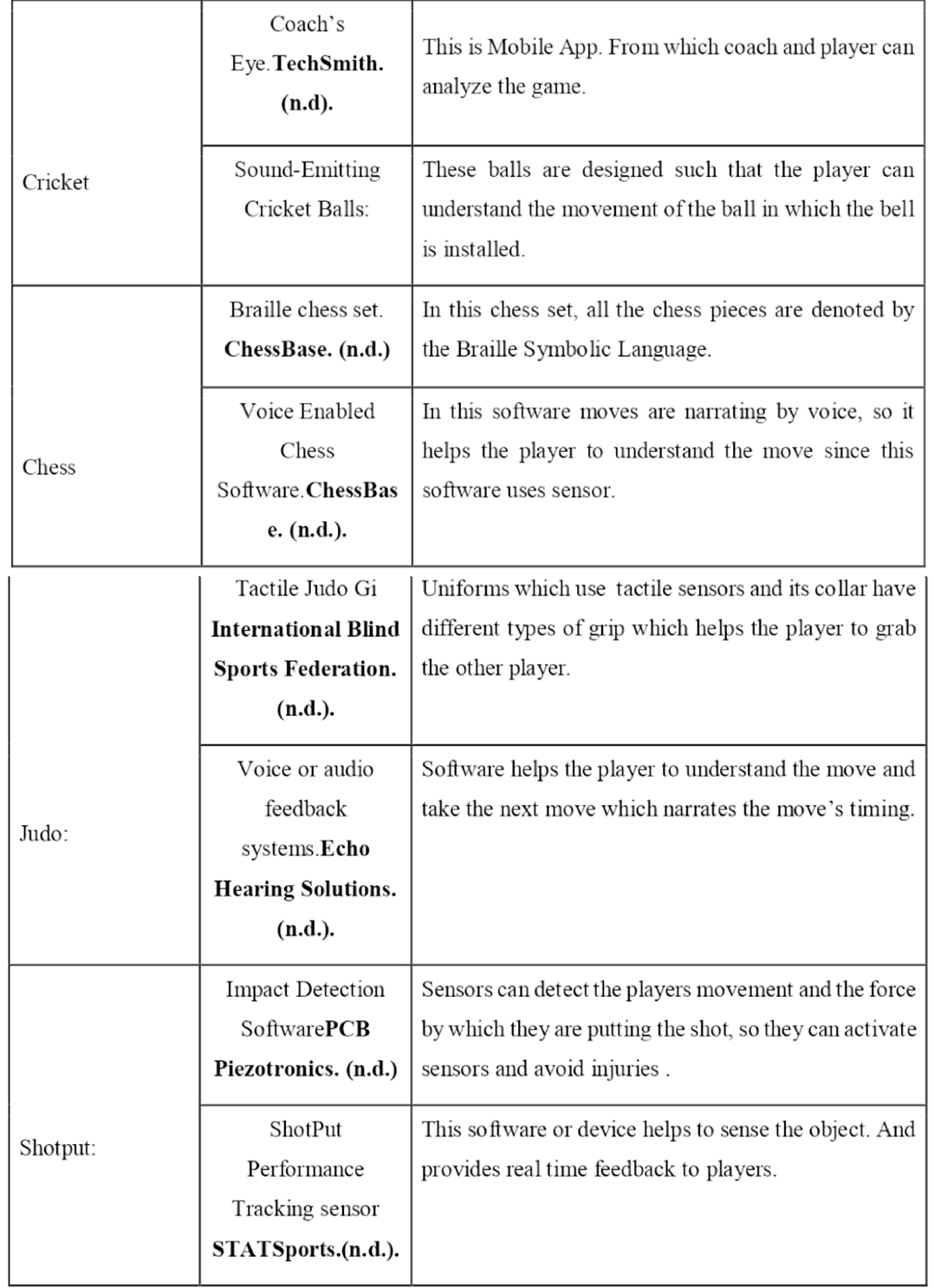
Table No. – 2 Device name and it’s working for different types of sports
Objective – 4
The fourth objective of the study is to suggest the concern for promoting deep technology for the visually impaired athletes. After all the study we have a conclusion and a few suggestions to
1) To Government of India
● We feel the Government should provide financial support to the players and also provide advanced devices for sports people who are visually challenged.
● The main issue was observed that no such technological help was available for players to enhance their skill or for safety purposes.
● The government should look after the proper management among the players regarding their regular practice and exercise.
● Government should encourage these athletes to show their skills and provide opportunities to them.
● Deep technology such as AI and Robotics using various sensors can be incorporated in the Paralympics for Visually Challenging Sports person.
2) To Fergusson College, Pune, Maharashtra
● College should try to arrange funding for Visually challenged players so that advanced technology can be made available to the players.
● They can arrange training programs for these players and increase awareness among these people about the deep tech used in sports.
● College must involve the visually challenged students to participate in sports and bring up some opportunities to improve their skills.
● Awareness should be made among visually challenged students about the latest technology which can be used by them to enhance their skills.
3) NGO (forVisually Challenged People)
● NGO can organize training and mentorship program.
● They may contribute in making technological devices.
● Most of the time they have collaboration with international bodies or governments so with the help they can arrange any workshop to increase the confidence of players.
CONCLUSION
The deep technology in sports can help to bridge the technological gap for the visually impaired players by enhancing performance using technology from audio guided swimming or Wearable devices like heart rate monitors, GPS trackers, and biomechanical sensors provide real-time feedback on a swimmer’s physical state to AI driven chess boards .This advancement will help to reshape the sports for Visually challenged players .Through discussion with visually impaired players of Fergusson
College, Pune, Maharashtra it is evident that though the technology is promising for the visually challenged players but its implementation should be more inclusive and accessible to the visually impaired players of all region. The researcher tried to find the gaps through the interview with the players and analysis of the literature available. From these it can be observed that though all over the world deep tech like AI, training Software etc. are available but the question comes to the accessibility at all regions and availability for players ranging from different socioeconomic backgrounds.
This paper is an attempt to suggest the concerns based on the above study for promoting deep tech in sports for Visually impaired athletes to enhance their skills and performances and make sports enjoyable for them as well.
REFERENCES
Anandaraj, P. R., Mahmood, N. H., Abdul Razak, M. A., & Zakaria, N. A. (2024). Digital chess clock for visually impaired players. Journal of Human Centered Technology, 3(1), 46–52.)
Blind Cricket England & Wales. (n.d.). Equipment. Blind Cricket England & Wales. Retrieved February 26, 2025
Bureau of Education for the Handicapped (DHEW/OE), Division of Innovation and Development, & Cordellos, H.C. (1972). Physical education for the handicapped. American Alliance for Health, Physical Education, and Recreation.
C.ho, H. C., Oh, H., Yoon, H., Jin, J., & Lee, J. W. (2018).Title of the article. International Journal of Sport and Health Sciences, 12(9), [page range]. World Academy of Science, Engineering and Technology.
ChessBase.(n.d.). Chess news. ChessBase .https://en.chessbase.com/
Dartfish.(n .d .) . Swimming.Dartfish .https://www.dartfish.com/swimming
Echo Hearing Solutions. (n.d.). Home. Echo Hearing Solutions. https://echohearing.in/Finke, B. (2021, August 31). How do blind and visually impaired people go swimming? The Chicago Lighthouse.
Hartono, F., Tangkudung, J., Sukur, A., & Dlis, F. (2020).Development of sensor-based blind swimming aids. International Association of Online Engineering.
International Blind Sports Federation. (n.d.). Home. International Blind Sports Federation. https://ibsasport.org/
Kerner, S. M. (n.d.). What is deep tech? TechTarget. Retrieved February 26, 2025
Khanna, R. C. (2018). Commentary: Childhood blindness in India : Regiona lva riations. Indi an Journal of Ophthalmology, 66(12), 1461–1462.
Krabben, K. J., van der Kamp, J., & Mann, D. L. (2017). Fight without sight: The contribution of vision to judo performance. Psychology of Sport and Exercise, 31, 1–8.
Misra, N., & Khanna, R. C. (2020). Commentary: Rapid assessment of avoidable blindness and diabetic retinopathy in India. Indian Journal of Ophthalmology, 68(2), 381–382.
Moein, S., Movahedi, M., & Ghasemzadeh, H. (2022). Eyetracking in sports: Understanding visual attention and perception in athletes. Virtual Reality, 26(4), 543-553. Jara,A., & Cifuentes, C. (2021). The impact of virtual reality on sports training: An overview of applications in physical performance. Sensors, 8(4),Blind Sport New Zealand. (n.d.). Cricket. Blind Sport New Zealand. Retrieved February 26, 2025
National Programme for Control of Blindness and Visual Impairment (NPCBVI). (2019). National Blindness and Visual Impairment Survey 2015-2019. Ministry of Health and Family Welfare, Government of India.
Panoutsakopoulos, V., & Panteli, F. (2013). Influence of visual impairment level on the regulatory mechanism used during the approach phase of a long jump. Perceptual and Motor Skills: Exercise and Sport PCB Piezotronics. (n.d.). Quartz impact force sensors. PCB Piezotronics.
Rao, G. N. (2000). Vision 2020: The Right to Sight. Community Eye Health, 13(35), 42. Retrieved April 8, 2018, from Sensoryx. (n.d.). Home. Sensoryx. https://sensoryx.tech/
STATSports. (n.d.). STATSports | APEX athlete series | GPS performance tracker. STATSports. https://statsports.com/ TechSmith. (n.d.). Coach’s Eye has been retired. TechSmith. https://go.coachseye.com/retirement/ Vision Australia. (2023, July 3). Scoring a century with the audible cricket ball. Vision Australia. Retrieved February 26, 2025
Wadhwani, M., Vashist, P., Singh, S., Gupta, V., Gupta, N., & Saxena, R. (2020). Prevalence and causes of childhood blindness in India: A systematic review. Indian Journal of Ophthalmology, 68(2), 311–315.
Woolsey, T. D., Woolsey, C. L., Strohmeyer, S., Walker, S.,
Otto, W., Cheshier, B. C., … & Jacobson, B. H. (2020). THE EFFECT OF ADVANCED IMAGERY TRAINING ON SHOT PUTTER PERFORMANCE. Journa l of Contemporary Athletics, 14(4).
World para Swimming Classification & Categories – SB9, SM8. (n.d.). International Paralympic Committee. Zebra Medical.( n . d).Home.ZebraMedical. https://zebramedical.com/