
IMPACT OF LOK SABHA EXIT POLLS ON CAPITAL MARKETS A DEEP TECH PERSPECTIVE
Author: Rohan Aggarwal, Vishwas Murmure, Abhijeet Sonawane DOI: https://doi.org/10.68120/IC2425C8 Page Numbers: 48 to 52
Keywords: Lok Sabha Elections, Deep Tech Multi-Agent Reinforcement Learning (MARL), Exit Polls, Financial Markets, Stock Indices.
Abstract: This research examines how Indian Lok Sabha elections influence financial markets, particularly stock indices, currency fluctuations, and investor sentiment. Findings indicate that exit polls significantly impact market movements, affecting investor confidence and trading behavior. The study also explores how policy changes and foreign direct investment (FDI) flows are influenced by election outcomes. This study proposes the use of Deep Tech Multi-Agent Reinforcement Learning (MARL) to simulate and predict capital market reactions to exit polls, leveraging AI-driven trading strategies to enhance decision-making in volatile election periods.
INTRODUCTION:
The Lok Sabha election is one of the most significant democratic exercises globally, as it determines the composition of the lower house of India’s Parliament. The Lok Sabha, or the “House of the People,” consists of 545 members, out of which 543 members are directly elected by the people of India, and 2 are nominated by the President to represent the Anglo-Indian community (a provision recently abolished in 2019) held every five years. Political parties field candidates across constituencies, and the party or coalition with a majority of seats (at least 272) is invited to form the government.
The Lok Sabha elections play a critical role in shaping India’s political and economic landscape. Political stability directly influences government policies, investor sentiment, stock prices, and foreign capital inflows. During election periods, financial markets experience increased volatility due to policy uncertainty. Investors rely on exit polls, macroeconomic indicators, and election results to make investment decisions. Informal betting markets, such as the Phalodi Betting Market, also serve as alternative indicators of public sentiment, potentially impacting short-term market trends.
OBJECTIVES
This study aims to:
1. Examine how Lok Sabha elections affect stock market volatility, investor sentiment, and trading patterns.
2. Analyze the accuracy of exit polls in predicting market movements and their influence on investment decisions.
3. Proposing use of Deep Tech MARL model in predicting and forecasting how Lok Sabha elections impact financial markets.
LITERATURE REVIEW
Amitesh Kapoor (2013) examined the effects of political events on the Indian stock market and the investment climate. His research underscores the importance of political stability and the anticipated outcomes of elections in shaping investor behaviour. Kapoor findings suggest that political events, including exit polls, can lead to substantial market fluctuations as investors react to the perceived likelihood of various electoral outcomes. (Kapoor, 2013)
G.D.V. Kusuma (2018) analysed the impact of elections on the National Stock Exchange (NSE) and Bombay Stock Exchange (BSE) indices, focusing on short- and mediumterm volatility. Kusuma’s study reveals that markets experience significant fluctuations during election periods, driven by investor speculation and sentiment. This implies that exit polls, which provide early indicators of electoral outcomes, may similarly affect stock market volatility, as investors adjust their portfolios based on expected political changes. (Balaji C., 2018)
Jatinder Loomba (2014) investigated the Indian stock market’s response to political leaders using EGARCH models. His research indicates that investor confidence is closely linked to political leadership, suggesting that favourable exit poll results for a particular leader could lead to bullish market behaviour, while negative polls might trigger bearish sentiment. This relationship highlights the relevance of exit polls in shaping market perceptions and reactions. (Loomba, 2014) Kavita Chavali (2020) studied the market’s response to consecutive election wins using event study methodology. Chavali’s findings suggest that markets tend to react positively to clear electoral victories, which can be extrapolated to the context of exit polls. When exit polls predict a strong lead for a candidate, it may enhance investor confidence and lead to positive market reactions, anticipating stability and continuity in governance.
(Kavita Chavali, 2020) Dr. Girish A. Bodhankar (2021) focused on volatility during 30-day windows around elections, providing insights into market behaviour during critical electoral periods. His research indicates that heightened volatility often accompanies elections, likely influenced by uncertainty and speculation surrounding political outcomes. This volatility can be accentuated by exit polls, as they may introduce additional uncertainty or reinforce existing sentiments, leading to rapid market adjustments. (Prof, 2020) Despite the valuable insights from existing studies, notable gaps remain concerning the specific impact of exit polls on the Indian stock market. Many studies focus broadly on elections without isolating the effects of exit poll data. Additionally, the role of psychological factors influencing investor behaviour in response to exit polls is often underexplored. Future research could benefit from real-time data analysis around exit polls, providing a nuanced understanding of their immediate effects on market dynamics.
DATA ANALYSIS
Polls & Results Lok Sabha 2004
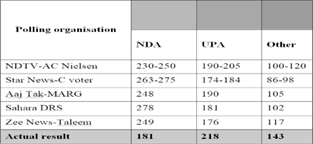

The election of the 2004 showed unexpected fall of the NDA Alliance. The polls showed one sided victory for UPA Alliance. The stock market was not expecting such election result giving negative fall of 4% on the polls and 12% downfall on the result day. The VIX hit 30.25 during this period. Lok Sabha 2009
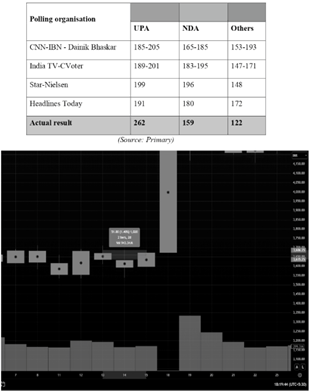
(Source: Primary)
The results of the 2009 election were much expected and pre-election result market didn’t react much to exit polls with minor movements of 1.47% positive tick. The result day the Indian markets gave its first ever upper circuit and 73% up move post the election result.
Lok Sabha 2014
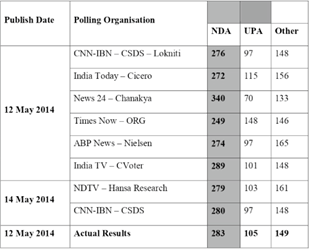
(Source: Primary)
The 2014 election was a complete Modi wave; it totally took the market in positive way. The markets continued to rally 20% pre-election and 28% post-election. The notable thing was VIX hit 36 during this period.

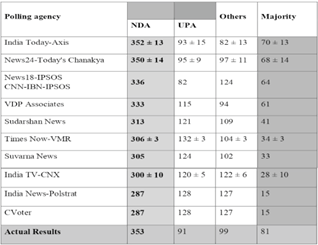
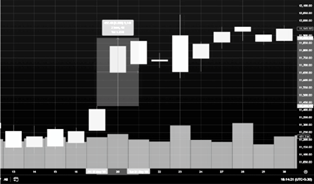
The market had already anticipated the return of NDA Alliance and didn’t react to that as much the markets remained sideways pre-election and post-election result it marginally corrected by -5%. The VIX remained at 23 during this period.
Lok Sabha 2024


(Source: Primary)
The results of 2024 were anticipated to get NDAAlliance a pure sweep on the INDIAAlliance. The Exit Polls suggested 340+ seats for the NDA. The results were quite the opposite and took everyone with surprise with NDA barely grabbing 293 seats and maintaining the government. The market which rallied during exit polls took a downturn on surprising results. The market was lagging due to the global trends and India VIX remained at 18.47 during the period.

Introduction to Market Volatility and Investor Awareness
Market volatility refers to the rapid and significant price fluctuations observed in financial markets, often triggered by uncertain events such as economic crises, geopolitical tensions, elections, or natural disasters. Unexpected events often shake up the balance between demand and supply in the market, leaving investors feeling unsure and anxious. While ups and downs are a normal part of financial markets, things tend to get more intense when the future feels unclear. This can affect stock prices, how much people are trading, and the general mood of the market. Such uncertainty brings both risk and opportunity. Sometimes, prices drop and give investors a chance to buy at lower rates. But for those who aren’t ready, it can lead to panic, quick selling, and losses. Tools like the VIX (Volatility Index) help track how uncertain the market is and can guide investors on when to be cautious. That’s why it’s important for investors to stay informed. Knowing how to spread out investments, manage risks, and stick to long-term goals can make it easier to deal with market ups and downs.
Correlation of Election with Indian Financial Markets
The outcome of the Lok Sabha election has a profound impact on Indian financial markets, reflecting the interconnectedness between political stability and economic confidence. Elections play a big role in shaping how the country is run, and the markets react quickly based on who might come to power and what their plans are. During election time, stock markets often become jumpier, as investors try to guess what changes might be coming.
If one party wins clearly and forms a stable government, investors usually feel more confident. It means economic policies are more likely to continue smoothly. But if the results are unclear or no party has a strong majority, markets may become nervous. People worry that important decisions might get delayed or stuck.
The outcome of elections doesn’t just affect stocks-it also impacts the value of the Indian rupee, interest rates on government bonds, and how much foreign money comes into the country. Governments that focus on reforms and growth tend to attract more foreign investment, which strengthens the economy and makes India more attractive to global investors. The new government’s choices around spending, borrowing, and inflation control also affect things like prices, interest rates, and how fast the economy grows. So, elections aren’t just about politics—they have a big influence on the economy and makes India more attractive to global investors.
The new government’s choices around spending, borrowing, and inflation control also affect things like prices, interest rates, and how fast the economy grows. So, elections aren’t just about politics—they have a big influence on the economy and the mood of investors, both in India and abroad.
How MARL Agents model works and Train Themselves for Predicting Election-Based Market Movements
Understanding How AI (MARL) Models Stock Market Reactions to Exit Polls: Multi-Agent Reinforcement Learning (MARL) is a smart way to use AI for predicting how the stock market might react to events like Lok Sabha exit polls. Unlike older methods, MARL doesn’t just rely on fixed formulas it learns by simulating how different types of investors behave in real-world situations.
Steps
1. Creating a Virtual Market
First, a virtual stock market is set up. In this environment, different AI agents represent real-life market participants like regular traders, big institutional investors, and highspeed trading firms. These agents “live” in the system and respond to changing political or economic news, such as exit poll results.
2. Learning Through Practice
Each AI agent makes decisions like buying, selling, or holding stocks. Based on the outcome (profit or loss), the agent gets a reward or penalty. Over time, they learn what strategies work best through trial and error—just like humans do.
3. Using Past Election Data
To train these agents, real historical data from Indian elections (1999 to 2019) is fed into the system. This includes exit poll results and how the stock market moved around those events. For example, the model might learn how PSU bank stocks reacted when polls suggested an uncertain or split verdict.
4. Making BetterPredictions
As these agents keep learning from more data and simulated experiences, the system becomes better at predicting how markets might move in response to future political scenarios. Trial-and-Error Learning: Agents test multiple trading strategies and optimize based on outcomes. Real-Time Adaptation: The model updates predictions dynamically using exit poll results, news sentiment, and institutional investor activity.
Example Training Scenario
● If an agent buys banking stocks before a stable government is confirmed and they rise the agent gets a reward.
● If an agent holds stocks during political uncertainty and they crash agent gets a penalty.
This process repeats millions of times across different historical elections until the AI finds the most profitable patterns.
Training on Historical Lok Sabha Election Data
The AI is fed past election results and stock market reactions to learn how different scenarios impacted the market:

The MARL model learns from these historical reactions and builds strategies that adapt dynamically to new elections.
Real-Time Learning from 2024 Elections (Live Market Data)
Once trained, the MARL system can process real-time exit poll results and adjust its trading strategies dynamically.
Example
● AI detects that exit polls are showing unexpected seat losses for the ruling party.
● The AI analyzes social media, news sentiment, and FII outflows to predict a potential market correction.
● The system executes automatic trades before human traders react, minimizing risks and maximizing profits. Building a MARL Model Key Components and Resources
1. Defining the Environment and Agents
Environment: Create a simulated world where agents operate, including state space, action space, and reward mechanisms. Agents Define agent types, objectives, and how they interact.
2. Choosing a Programming Language
Python: Preferred for MARL due to its extensive libraries and community support.
Key Libraries
▪ Tensor Flow Deep learning model training.
▪ Py Torch Flexible for research applications.
▪ Ray RLlib Scalable reinforcement learning framework.
3. MARL Frameworks and Libraries
Petting Zoo Provides diverse environments for MARL research.
MAgent Simulates large-scale multi-agent interactions efficiently.
MARL lib Aunified interface for MARL algorithms.
4. Implementing Learning Algorithms
Algorithm Selection Choose appropriate models such as MADDPG (Multi-Agent Deep Deterministic Policy Gradient) or QMIX.
Training Process Ensure agents learn effectively through interaction.
5. Leveraging Educational Resources
Research Papers: Review foundational and recent studies on MARL.
GitHub & Online Courses: Access hands-on learning materials.
6. Experimentation and Optimization Simulation Test agent behaviours in dynamic environments.Performance Evaluation Assess metrics like cumulative rewards and strategy efficiency.
Optimization Fine-tune parameters for better decisionmaking and cooperation.
Contrasting MARL with Traditional Models
● Time Series Models (ARIMA, LSTM) Predictive accuracy~50-54%, struggling with sudden political volatility.
● Sentiment Analysis Models Accuracy ~60-70%, but lacks market interaction dynamics.
● MARL Superiority By incorporating multi-agent learning, MARL dynamically adjusts to real-time data, leading to higher predictive potential in election-driven markets.
Unlike these traditional models, MARL dynamically learns from real-world interactions among multiple investor types, making it more adaptive and effective in volatile election driven markets. Additionally, while standard Reinforcement Learning (RL) models focus on a single agent learning framework, MARL’s multi-agent system enhances its predictive power by simulating the competitive and cooperative nature of real financial markets. This multi-agent approach provides a more robust prediction of stock movements during political uncertainty.
MARL Agents train themselves by simulating millions of market conditions based on past elections, learning optimal
trading strategies through trial-and-error, adapting instantly to new exit poll data using real-time learning and continuously improving trading decisions without human intervention.
The final output will an AI-powered predictive model that accurately forecasts how Lok Sabha elections impact financial markets before results are officially announced.
CONCLUSION
This study highlights the significant influence of Lok Sabha elections on Indian financial markets, demonstrating how political stability and uncertainty drive market trends. Traditional forecasting models, such as time series analysis and sentiment analysis, struggle to adapt to real-time election-induced volatility, limiting their predictive accuracy. In contrast, Multi-Agent Reinforcement Learning (MARL) offers a more dynamic and precise approach by simulating investor behavior and market interactions. The findings suggest that clear election mandates typically lead to market rallies, while uncertainty results in corrections. Investors can leverage AI-driven insights to anticipate market reactions, while policymakers can use these models to implement stability measures.
Future research can focus on refining MARL with real-time data integration, extending its applicability to global markets, and enhancing AI explainability for broader institutional adoption. By incorporating high-frequency trading data and alternative market indicators, MARL can further improve its predictive accuracy. Additionally, expanding its application to other emerging economies can validate its effectiveness across different political systems. Overall, MARL presents a transformative framework for election-based market forecasting, offering an adaptive and data-driven approach to financial decision-making.
REFERENCES
Balaji C., K. G. (2018). Impact of General Elections on Stocks Markets in India. Open Journal of Economics and Commerce, 1-7.
Kapoor, A. (2013). Effect of Political Decision Making on Indian Capital Markets . International Journal of Research in Management , 3(1).
Kavita Chavali, A. M. (2020). Stock Market Response to Elections: An Event Study Method . The Journal of Asian Finance, Economics, and Business, 9-18.
Loomba, J. (2014). 16th Lok Sabha Elections and Contagion Effects to Indian Stock Market . Asia Pacific Journal of Management & Entrepreneurship Research, 133.
Prof, G. A. (2020). The Impact of the General Election and the Parties Leading the Governement on the Stock Market Index in India. Nevilla Wadia Institute of Mangement Studies & Research, 88-96.